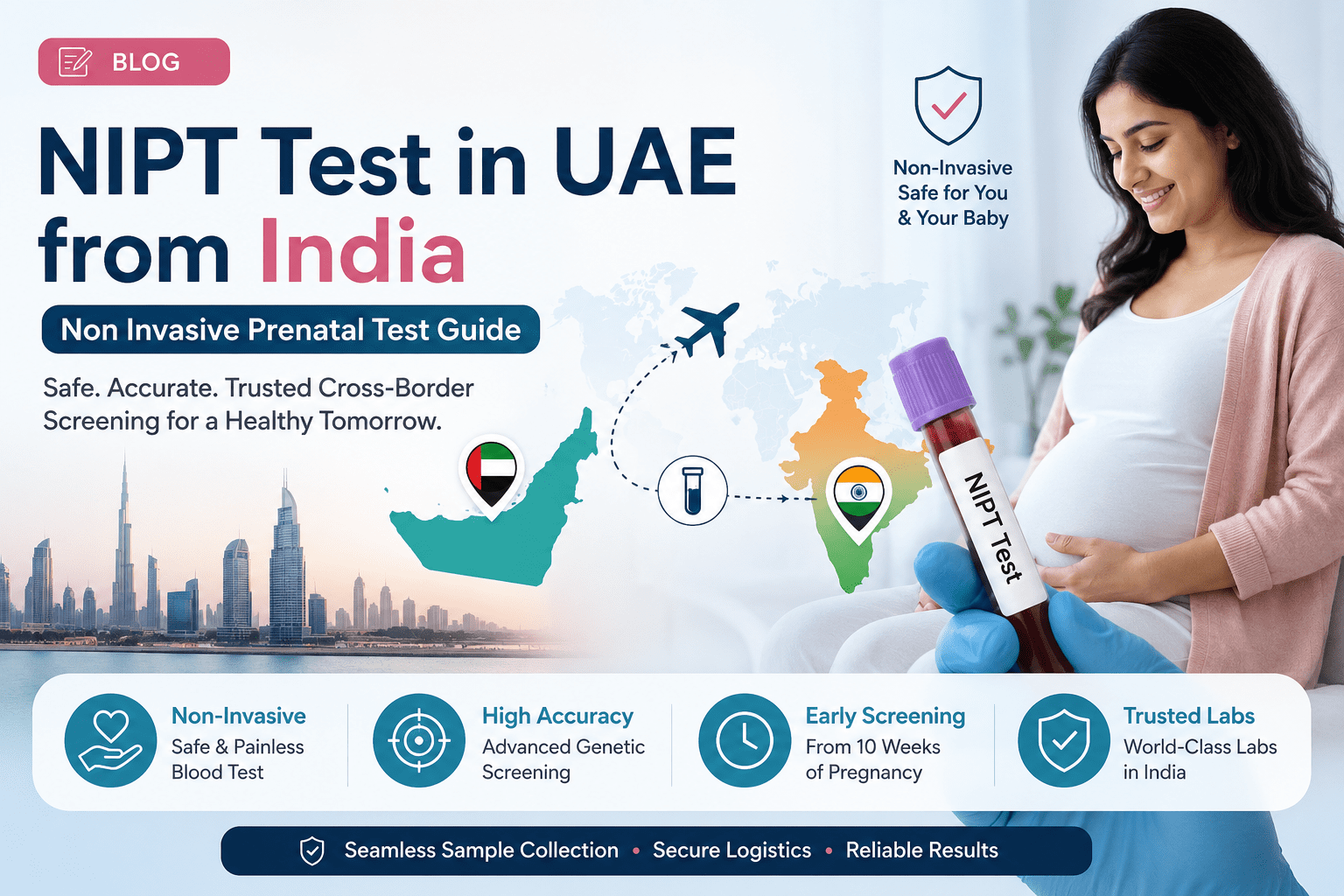
If you are pregnant in the UAE and have been told your blood sample needs to travel to a laboratory in India, you are not alone, and you have not been handed a second-rate option. Cross-border NIPT is now one of the most common ways expectant parents across Dubai, Abu Dhabi, and Sharjah access advanced prenatal genetic screening. This guide explains exactly how a NIPT Test in UAE from India works, what it screens for, how sample collection and logistics are handled safely, and what to expect from start to finish report.
The Non-Invasive Prenatal Test has changed early pregnancy screening more than almost any tool in the last decade. It carries no risk to your baby, it can be done from around the tenth week, and when routed through an established Cross Border NIPT Service UAE pathway, it gives you access to laboratory capacity and pricing that many families find hard to match locally.
What Is a Non-Invasive Prenatal Test?
A Non-Invasive Prenatal Test is a screening method that estimates the chance your baby could be born with certain genetic conditions. It does this from a single tube of the mother’s blood. Nothing is inserted near the womb. No needle goes anywhere near the baby. That is the whole point of the word non-invasive.
Here’s how it works at the biological level. During pregnancy, your bloodstream carries tiny broken fragments of DNA. Some come from your own cells, and some come from the placenta. Because the placenta shares the baby’s genetic makeup, scientists can read those placental fragments to learn about the fetus. These free-floating pieces are called cell-free DNA, or cfDNA, and they appear in the mother’s blood throughout pregnancy as cells break down and release their contents.
The lab counts and analyses these fragments. If the proportion coming from a particular chromosome is higher than expected, it flags an increased chance of a condition tied to that chromosome. If everything sits in the normal range, the result comes back low-risk.
One detail matters a lot here. There has to be enough fetal DNA in your blood for the test to work. This proportion is called the fetal fraction, and it generally needs to be above 4 percent, a level that is usually reached around the tenth week of pregnancy. Testing too early, or other factors such as maternal weight, can lower that fraction and occasionally make a redraw necessary. That is not a failure of the test. It is just biology, and a good clinic will explain it before you ever sit down for the blood draw.
This screening sits inside the broader field of Prenatal Genetic Testing UAE families increasingly ask for, and it has become a first-line choice precisely because it pairs strong detection rates with zero physical risk to the pregnancy.
Why People Choose a NIPT Test in UAE from India
So why route the test across a border at all? Three reasons come up again and again.
Laboratory access and scale. India hosts some of the highest-volume genetic laboratories in the region. High volume usually means refined workflows, faster turnaround, and consistent quality control. For an expectant parent in the Emirates, a well-run NIPT Test in UAE from India simply taps into that capacity.
Cost. This is the honest, practical driver for a lot of families. Cross-border processing can bring the price of advanced screening down considerably compared with running everything entirely in-market. When you are budgeting for an entire pregnancy and delivery, that gap is not trivial.
Continuity for Indian expats. A large share of the UAE’s expectant population has roots in India. Many want results processed by laboratories they already trust, sometimes the same labs their families have used for years. A Cross Border NIPT Service UAE model lets them keep that continuity without flying home.
Let’s be honest about one thing, though. The cross-border element only works when the logistics are airtight. A blood sample is a living, time-sensitive thing. The entire value of choosing a Non Invasive Prenatal Test UAE through an India-based lab rests on the sample arriving in good condition, on time, with full documentation. We will get into exactly how that is managed further down.
What NIPT Screens For
NIPT is most often used to look for chromosomal disorders caused by an extra or missing copy of a chromosome, a situation geneticists call aneuploidy. The core panel almost always covers the conditions below.
- Down syndrome (Trisomy 21): caused by an extra copy of chromosome 21. This is the most common condition NIPT detects, and detection rates for it are high.
- Edwards syndrome (Trisomy 18): caused by an extra chromosome 18.
- Patau syndrome (Trisomy 13): caused by an extra chromosome 13.
- Sex chromosome conditions: extra or missing copies of the X and Y chromosomes, such as Turner syndrome and Klinefelter syndrome. These also let the test report fetal sex, where local regulations permit disclosure.
Many modern panels go further. Expanded versions can screen for microdeletions, which are small missing sections of a chromosome, and the technology is beginning to reach into single-gene disorders too. As sequencing costs fall, the range of conditions a single Non-Invasive Prenatal Test can flag keeps widening. Researchers broadly expect that NIPT will eventually screen for many more genetic conditions than it does today.
Worth noting: because the test reads both fetal and maternal DNA, it occasionally surfaces a genetic finding in the mother rather than the baby. That is rare, but it is a reason results should always be interpreted by a clinician rather than read off a sheet alone.
How NIPT Sample Collection India to UAE Actually Works
This is the part most articles skip, and it is the part that actually matters when you choose a cross-border provider. NIPT Sample Collection India to UAE is not a single step. It is a chain, and every link has to hold.
Here is the typical journey, start to finish.
Step 1: Consultation and eligibility check
Before any blood is drawn, a clinician confirms you are far enough along, usually at least ten weeks, so the fetal fraction is likely high enough. They review your history, explain what the test can and cannot tell you, and obtain informed consent. Skip this step and you risk an inconclusive result and a wasted sample.
Step 2: Blood draw in the UAE
A standard maternal blood sample is collected at the clinic in Dubai, Abu Dhabi, or wherever you are. This is no different from any routine blood test. One or two specialised tubes, a few minutes, done.
Step 3: Stabilisation and packaging
This is where cross-border logistics earn their keep. The sample is collected into tubes containing a preservative that keeps the cell-free DNA stable during transit. It is then packed to maintain the right temperature and protected against vibration and delay. Proper stabilisation is the single biggest factor in whether a cross-border sample arrives usable.
Step 4: Documented cross-border transport
The packaged sample, with its paperwork and chain-of-custody documentation, is shipped to the partner laboratory in India through a tracked medical-courier pathway. Good providers give you a reference so you, and they, can follow the sample’s progress.
Step 5: Laboratory processing
At the Indian lab, the cfDNA is extracted and sequenced. The analysis counts fragments across the relevant chromosomes and compares them against expected ranges. This is the scientific heart of the whole Prenatal Genetic Testing UAE journey.
Step 6: Report delivery and clinical interpretation
The finished report is returned to your UAE clinic, where your clinician walks you through it. A low-risk result is reassuring but not a guarantee. A high-risk result is not a diagnosis; it is a signal to consider confirmatory testing.
The strength of any Cross Border NIPT Service UAE lives in steps three and four. When stabilisation and transport are handled by people who do this every day, the cross-border distance becomes a non-issue. When they are not, you get redraws and delays. Choose your provider on the strength of their logistics, not just their lab’s name.
Who Should Consider This Test
NIPT is offered widely now, not only to so-called high-risk pregnancies. That said, certain situations make the conversation more pressing.
- Maternal age over 35, where the baseline chance of chromosomal conditions rises.
- A previous pregnancy affected by a chromosomal condition.
- An abnormal or borderline result from an earlier ultrasound or first-trimester screen.
- A family history of certain genetic conditions.
- Parents who simply want early, low-risk information and the reassurance it can bring.
If you fall into none of these categories, NIPT is still an option. Plenty of parents choose it purely for early peace of mind, and there is nothing wrong with that. The test’s no-risk profile is exactly what makes it accessible to everyone, not just those flagged as high-risk.
Accuracy, Limitations, and What “Screening” Really Means
Let’s clear up the single most misunderstood thing about NIPT. It is a screening test, not a diagnostic one. That distinction is not a technicality. It shapes how you should read every result.
A screening test estimates risk. It tells you whether the chance of a condition is increased or decreased. It does not give a yes or no. A diagnostic test, by contrast, aims to confirm or rule out a condition outright.
What does that mean in practice?
A false positive can happen, where the result flags increased risk but the baby is actually unaffected. A false negative can also happen, where the result reads reassuring but the condition is present. Both are uncommon for the main trisomies, but neither is impossible, which is exactly why a high-risk NIPT result should be followed by confirmatory diagnostic testing before any major decision.
The fetal fraction issue resurfaces here too. If there is not enough fetal DNA in the sample, the lab may be unable to produce a confident result, leading to a “no-call” and a possible redraw. Reasons include testing too early, sampling issues, and higher maternal weight.
None of this should put you off. Detection rates for Down syndrome in particular are very strong, well ahead of older blood-and-ultrasound combined screening. The point is to use the test for what it is: a powerful, risk-free early filter that tells you whether deeper testing is worth considering.
Key takeaway: A reassuring NIPT result lowers your worry. A concerning one points you toward the next step. Neither one is a final diagnosis on its own.
NIPT vs Other Prenatal Tests: A Comparison
Parents often arrive confused about how NIPT stacks up against the older tests their mothers may have had. The two tables below lay it out plainly.
Table 1: NIPT Compared with Other Prenatal Tests
| Feature | Non-Invasive Prenatal Test (NIPT) | Combined First-Trimester Screening | Amniocentesis / CVS |
| Type | Screening | Screening | Diagnostic |
| Sample | Maternal blood only | Maternal blood + ultrasound | Amniotic fluid / placental tissue |
| Risk to pregnancy | None | None | Small procedure-related risk |
| Earliest timing | From ~10 weeks | ~11–14 weeks | From ~15 weeks (amnio) |
| Detection rate (Down syndrome) | Very high | Moderate | Definitive |
| Gives a definite diagnosis | No | No | Yes |
| Best used as | First-line screen | Older screening option | Confirmation after positive screen |
Table 2: In-Market vs Cross-Border NIPT (UAE Context)
| Factor | NIPT processed locally in UAE | NIPT Test in UAE from India (cross-border) |
| Blood draw location | UAE clinic | UAE clinic |
| Where DNA is analysed | UAE laboratory | Partner laboratory in India |
| Typical cost | Higher | Often more affordable |
| Logistics complexity | Lower | Requires stabilised, tracked transport |
| Continuity for Indian expat families | Limited | Familiar, trusted labs |
| Turnaround | Comparable when logistics are solid | Comparable when logistics are solid |
The takeaway from both tables is consistent. NIPT is the strongest no-risk screening option available, and the cross-border route changes nothing about the test itself, only the path the sample takes to be analysed.
Reading Your NIPT Report
When your report lands, it will most likely use the language of “low risk” or “high risk” rather than “positive” or “negative.” Here is how to interpret the common outcomes without spiralling.
Low-risk result. The chance of the screened conditions is reduced. This is the outcome most parents receive. It is genuinely reassuring, but remember it is a probability, not a certificate.
High-risk result. The chance of a specific condition is increased. This does not mean your baby has the condition. It means the next sensible step is a conversation with your clinician about diagnostic testing to confirm or rule it out.
No-call or inconclusive. The lab could not generate a confident result, often due to low fetal fraction. Usually this just means a redraw a little later in the pregnancy.
The one rule that holds across every result: interpret it with a clinician, in the context of your full pregnancy picture. A report read in isolation, late at night, through a search engine, will only cause unnecessary alarm. That is true of any Prenatal Genetic Testing UAE result, NIPT included.
Cost, Timelines, and Logistics
People want real numbers, and they want to know how long they will be waiting. Costs vary by panel, provider, and how many conditions you choose to screen for, so this guide will not invent a figure your provider has to honour. What it will do is set expectations.
A NIPT Test in UAE from India generally moves through these phases:
- Booking and blood draw: same day, often within minutes of arriving.
- Stabilisation and dispatch: the same day as collection, ideally, to protect sample quality.
- Transit to the partner lab: a tracked medical-courier window.
- Laboratory analysis: the sequencing and analysis stage.
- Report and consultation: returned to your UAE clinic for clinician-led interpretation.
When you compare quotes, do not just compare the headline price. Ask what the panel actually covers, whether redraws are included if the fetal fraction comes back low, and how the provider handles the cross-border transport. A slightly cheaper test that skimps on stabilisation logistics is not cheaper at all once you factor in a failed sample.
A solid Cross Border NIPT Service UAE will be transparent about all of this before you commit. If a provider cannot clearly explain how your sample gets to India and back, that is your answer.
Final Thoughts
Choosing a NIPT Test in UAE from India is not a compromise. For thousands of expectant parents across the Emirates, it is a smart, well-trodden route to advanced prenatal screening that carries zero physical risk to the pregnancy. The Non-Invasive Prenatal Test itself is the same powerful tool whether the analysis happens down the road or in a high-volume laboratory across the Arabian Sea. What changes is access, cost, and continuity, and for many families those three things tip the balance.
The thing to get right is the chain. A trustworthy Cross Border NIPT Service UAE provider will be open about how your sample is stabilised, transported, tracked, analysed, and interpreted. Ask those questions early. Get your clinician to walk you through the result when it arrives. And remember that screening points the way; it does not deliver verdicts.
If you are weighing up Prenatal Genetic Testing UAE options, speak to a qualified clinician about whether NIPT, and a cross-border pathway, fits your pregnancy. Early, risk-free information is one of the most reassuring things modern medicine can offer an expectant parent.