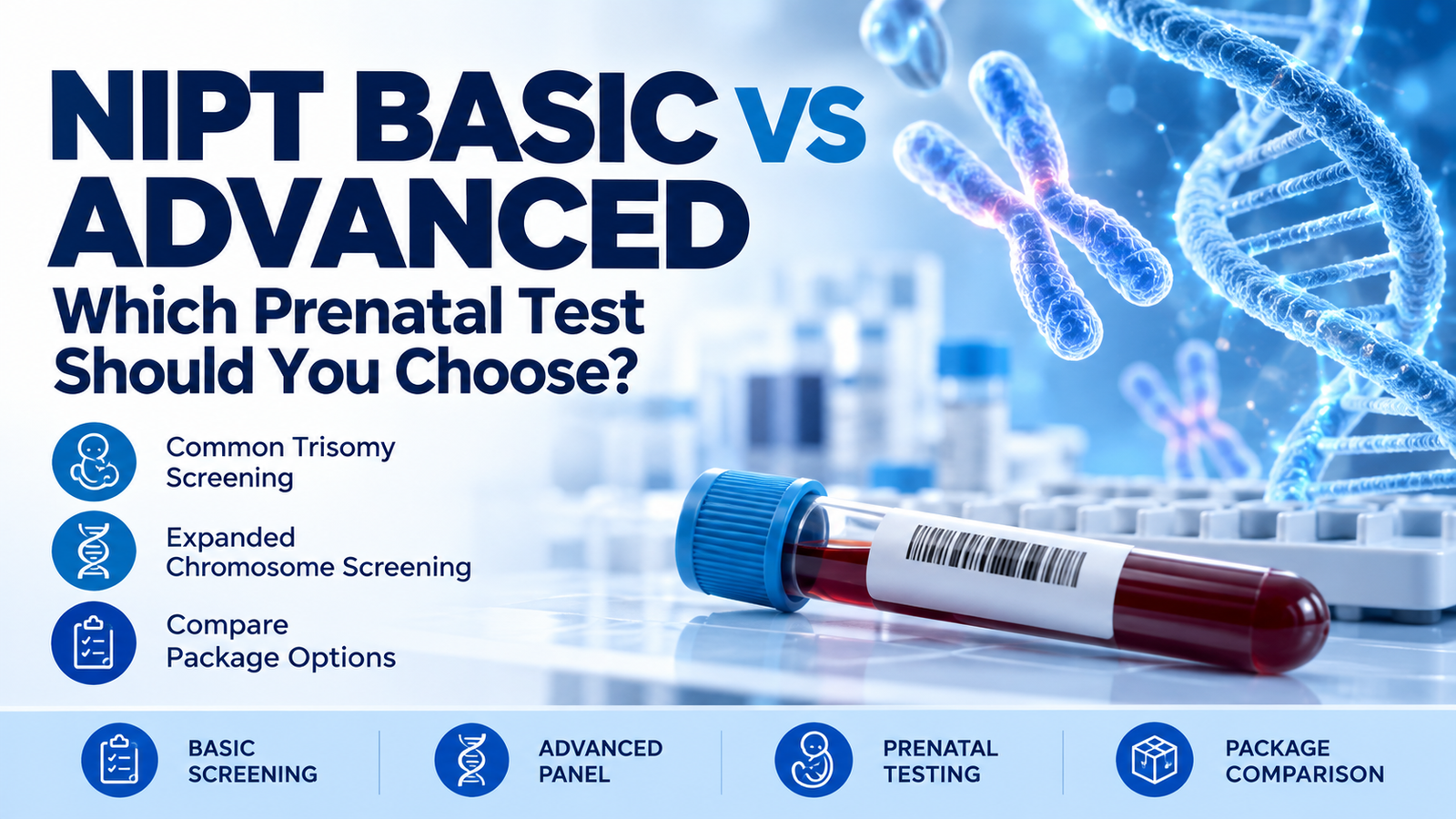
Choosing between NIPT Basic and NIPT Advanced depends on the chromosome conditions you want to screen for, your medical history, and your budget. This guide compares their coverage, accuracy, limitations, and costs before discussing the most suitable option with your doctor.
What Is NIPT and What Does It Screen For?
Non invasive prenatal testing (NIPT), also called cell free DNA screening, is a blood test used during pregnancy to assess the chance of certain chromosome conditions in the developing baby. It analyses small fragments of DNA in the pregnant person’s blood, most of which come from the pregnant person, along with fragments released by the placenta.
NIPT does not require a needle to enter the uterus. A healthcare professional collects a blood sample from the arm and sends it to a laboratory for analysis. The test is generally available from 10 weeks of pregnancy, although the testing provider will confirm its requirements.
NIPT is a screening test, not a diagnostic test. A high risk result means that a chromosome condition is more likely, but it does not confirm that the baby has that condition. A low risk result reduces the likelihood of the conditions screened for, but it cannot rule out every genetic or developmental condition.
Common chromosome conditions screened by NIPT
The Basic and Advanced packages described here include screening for three common trisomies.
-
Trisomy 21, or Down syndrome: This condition occurs when a person has an extra copy of chromosome 21. It can affect learning, development, and physical health.
-
Trisomy 18, or Edwards syndrome: This condition occurs when there is an extra copy of chromosome 18. It is associated with serious developmental and medical complications.
-
Trisomy 13, or Patau syndrome: This condition results from an extra copy of chromosome 13 and can cause severe developmental abnormalities and significant health problems.
Both packages also include screening for gonosomal chromosomes, which are the sex chromosomes. These chromosomes are usually X and Y. Changes in their number can be associated with conditions such as Turner syndrome and Klinefelter syndrome, depending on the screening panel.
The exact conditions included in sex chromosome screening should be confirmed with the testing provider.
NIPT Basic vs NIPT Advanced: Package Comparison
The main difference between NIPT Basic and NIPT Advanced is the range of chromosome conditions included in the screening panel. Both cover trisomies 21, 18, and 13, sex chromosome screening, and gender reveal. The Advanced package adds screening across 22 autosomal chromosomes and 10 microdeletions.
| Feature | NIPT Basic | NIPT Advanced |
|---|---|---|
| Price in Dubai | AED 850 | AED 1,200 |
| Trisomy 21 screening | Included | Included |
| Trisomy 18 screening | Included | Included |
| Trisomy 13 screening | Included | Included |
| Sex chromosome screening | Included | Included |
| Gender reveal | Included | Included |
| Screening across 22 autosomal chromosomes | Not listed | Included |
| Screening for 10 microdeletions | Not listed | Included |
The Advanced package costs AED 350 more than the Basic package. This represents approximately 41% more than the Basic package price. The additional cost pays for a broader screening panel, rather than a replacement for the common trisomy screening included in both options.
However, a wider panel does not automatically mean that every additional screening test is necessary for every pregnancy. The value of expanded screening depends on the conditions being assessed, the laboratory’s test performance, and the advice provided by a qualified healthcare professional.
Before booking either package, ask for the laboratory’s full list of conditions, the limitations of each test, and the expected time for receiving the report.
What Does the NIPT Basic Package Include?
The NIPT Basic package costs AED 850 and includes screening for trisomy 21, trisomy 18, trisomy 13, and gonosomal chromosomes. It also includes gender reveal.
This package covers several important chromosome conditions that are commonly assessed through prenatal screening. It provides information that can help expectant parents and their doctors decide whether further assessment is appropriate.
The Basic package does not list the broader autosomal chromosome screening or the 10 microdeletion screenings included in the Advanced package. If you want to assess these additional conditions, discuss the available options with your doctor.
Trisomy 21, Trisomy 18 and Trisomy 13
The three common trisomies are important targets of prenatal screening because they are associated with significant differences in development and health.
NIPT analyses cell free DNA fragments in the maternal blood sample to estimate the chance of these conditions. It is generally more accurate for screening for Down syndrome than traditional screening methods, although performance varies by condition and the laboratory’s method.
The test does not examine every gene or detect every possible chromosome change. It also cannot predict the full range of health needs or developmental outcomes of a child.
Sex Chromosome Screening and Gender Reveal
Sex chromosome screening assesses the possibility of certain differences involving the X and Y chromosomes. Depending on the laboratory’s panel, this can include screening for conditions associated with an unusual number of sex chromosomes.
Gender reveal is also included in both packages listed here. The result is based on the analysis of sex chromosome information in the blood sample.
It is important to distinguish gender reveal from screening for sex chromosome conditions. They are related to chromosome analysis, but they are not the same service. Ask the provider how gender information is reported and whether it is included automatically in the final report.
Who May Consider the Basic NIPT Package?
The Basic package may be an option for pregnant people who want screening for the three common trisomies and the listed sex chromosome panel without the additional screening included in the Advanced package.
Before choosing it, consider the following points.
-
Discuss your pregnancy history, current gestational age, and any previous screening results with your doctor.
-
Ask whether the standard screening panel meets your clinical needs.
-
Confirm whether your doctor recommends any additional assessment based on your ultrasound findings or family history.
-
Check the exact inclusions and limitations of the package before paying.
The final decision should reflect your clinical circumstances and preferences rather than price alone.
What Additional Screening Does NIPT Advanced Offer?
The NIPT Advanced package costs AED 1,200. It includes the screening offered in the Basic package, along with screening across 22 autosomal chromosomes and 10 microdeletions.
These additional features expand the range of chromosome changes being assessed. However, the exact conditions covered and the ability of the laboratory to detect them depend on the test method and its validated performance.
The package description alone does not identify all the specific chromosome changes or microdeletion conditions covered. Request the laboratory’s official panel before booking if these additional tests are important to your decision.
Screening Across 22 Autosomal Chromosomes
Humans typically have 23 pairs of chromosomes. The first 22 pairs are called autosomes, while the 23rd pair consists of the sex chromosomes.
The three common trisomies assessed in the Basic package involve chromosomes 21, 18, and 13. Screening across 22 autosomal chromosomes provides a broader assessment of chromosome abnormalities, depending on the laboratory’s method.
This does not mean that every possible change in all 22 chromosomes can be detected. Some chromosome changes are too small or complex for a particular screening method to identify reliably.
Ask the provider whether the panel screens for whole chromosome number changes only or also assesses other chromosome abnormalities. The answer will help you understand what the Advanced package adds to the standard panel.
What Are Microdeletions and Which Conditions Are Screened?
A microdeletion occurs when a small section of a chromosome is missing. The effects depend on the location and size of the missing section and the genes it contains.
Some microdeletions are associated with developmental, learning, physical, or medical conditions. Others can have different effects depending on the specific genetic change.
The Advanced package includes screening for 10 microdeletions, but the supplied package details do not name the 10 conditions. The exact list must be confirmed with the testing laboratory rather than assumed from another provider’s panel.
Microdeletion screening also has important limitations. These conditions are often rare, which means a positive screening result does not always indicate that the baby has the condition. Some microdeletion screens have lower positive predictive values than screening for common trisomies.
Professional guidance does not recommend routine general population screening for all microdeletion conditions. Anyone considering this type of screening should discuss its benefits, limitations, and possible follow up tests with a qualified healthcare professional.
What Additional Findings Can Advanced NIPT Detect?
The Advanced package can assess a broader range of chromosome changes than the Basic package, according to the listed inclusions. This may provide additional information for families who want to discuss expanded prenatal screening with their doctor.
However, additional screening can also produce uncertain or unexpected findings. A high risk result may require further testing, while a no call result means that the laboratory could not provide a reliable screening result from the sample.
Before choosing the Advanced package, ask the provider these questions.
-
Which 10 microdeletion conditions are included?
-
What types of chromosome changes can the test detect?
-
What are the reported detection rates and limitations for each condition?
-
What happens if the result is high risk or inconclusive?
-
Are genetic counselling and follow up diagnostic tests included in the package price or charged separately?
These details help you compare the actual clinical value of each package rather than relying on the number of conditions advertised.
Is NIPT Advanced Worth the Extra AED 350?
NIPT Advanced costs AED 350 more than NIPT Basic and includes broader chromosome and microdeletion screening. Whether the additional cost is worthwhile depends on the information you want, your clinical circumstances, and the limitations of the additional screening.
There is no single package that is automatically the best choice for every pregnancy. Both options cover the three common trisomies, but the Advanced package assesses additional conditions that are not listed in the Basic package.
When the Basic Package May Be a Suitable Option
The Basic package may be suitable for someone seeking screening for common trisomies and the listed sex chromosome conditions, without the expanded panel.
Consider the following factors when discussing this option with your doctor.
-
Screening priorities: You want to assess the common trisomies included in the package.
-
Clinical advice: Your doctor considers the standard screening panel appropriate for your circumstances.
-
Budget: You prefer the AED 850 option and understand the conditions it does not cover.
-
Test limitations: You recognise that a low risk result cannot exclude every chromosome or genetic condition.
Choosing Basic does not mean that you are neglecting prenatal care. The important point is to understand what it screens for and whether additional assessment is recommended.
When to Discuss Expanded Screening With Your Doctor
The Advanced package may be worth discussing if you want broader chromosome screening and are prepared to consider the limitations of microdeletion screening.
Your doctor can help determine whether the additional panel is relevant to your pregnancy. This discussion is particularly important if previous screening or ultrasound findings have raised concerns about a possible chromosome condition.
Expanded screening should not replace genetic counselling or diagnostic testing when either is indicated. It is also important to understand that a broader panel can increase the chance of receiving findings that need further investigation.
Why More Screening Does Not Always Mean Better Screening
A test that screens for more conditions is not necessarily more accurate for every condition. Each condition has its own detection rate, false positive rate, and positive predictive value.
For example, a screening test can have high sensitivity but still produce a positive result in a pregnancy where the condition is not present. This is more likely to be a concern when screening for rare conditions in a general population.
The best choice is the package that provides clinically useful information for your situation, with clear expectations about what the results can and cannot tell you.
NIPT Accuracy, Limitations and Follow Up
NIPT is a highly effective screening method for common trisomies, particularly Down syndrome. However, its accuracy varies according to the condition being screened for, the laboratory method, and factors related to the pregnancy.
The test analyses DNA fragments that mainly come from the pregnant person and the placenta. Because placental DNA does not always reflect the baby’s chromosome status exactly, a result can occasionally differ from the baby’s actual condition.
How Accurate Is NIPT for Down Syndrome?
NIPT has very high sensitivity and specificity for screening for Down syndrome. These measures describe how well a test identifies pregnancies with and without the condition in the population being assessed.
Sensitivity refers to the proportion of affected pregnancies correctly identified as high risk. Specificity refers to the proportion of unaffected pregnancies correctly identified as low risk.
Positive predictive value is also important. It describes the chance that a pregnancy actually has the condition after a high risk result. This value depends partly on how common the condition is in the population being tested.
A single accuracy percentage should not be applied to every condition or every NIPT panel. Ask the provider for the laboratory’s validated performance information, particularly for the additional conditions included in the Advanced package.
Can NIPT Give a False Positive or False Negative Result?
Yes. A false positive occurs when the test indicates a high risk result even though the baby does not have the condition. A false negative occurs when the test reports a low risk result even though the condition is present.
Several factors can contribute to these results.
-
Placental differences: The chromosome pattern in the placenta can differ from that of the baby.
-
Low fetal fraction: The sample may contain too little placental DNA for reliable analysis.
-
Rare biological factors: Some chromosome changes in the pregnant person or other biological factors can affect interpretation.
-
Technical limitations: No screening method detects every possible chromosome abnormality.
A low risk result is reassuring for the conditions screened for, but it does not guarantee that the baby has no genetic or developmental condition. Routine prenatal care and recommended ultrasound examinations remain important.
What Happens After a High Risk or No Call Result?
A high risk result is not a confirmed diagnosis. Your doctor may recommend genetic counselling, a detailed review of the pregnancy, and diagnostic testing to determine whether the condition is present.
Diagnostic tests such as chorionic villus sampling (CVS) and amniocentesis can examine genetic material from the pregnancy more directly. The appropriate test and timing depend on gestational age and the condition being investigated.
A no call result means that the laboratory could not provide a reliable result. This can happen because of low fetal fraction or other technical or biological factors. Your doctor may discuss repeating the blood test, performing an ultrasound, or considering diagnostic testing based on your circumstances.
Do not make major pregnancy decisions based on a screening result alone. Seek timely advice from your obstetrician or a qualified genetic counsellor.
When Can You Take NIPT in Dubai?
NIPT is generally available from 10 weeks of pregnancy. The exact requirements depend on the testing laboratory and the type of screening selected.
The test usually involves a blood sample collected at a diagnostic centre or another approved collection location. The sample is sent to a laboratory for analysis, and the report is shared according to the provider’s process.
Minimum Gestational Age for NIPT
Most standard NIPT tests can be performed from 10 weeks of pregnancy. Taking the test too early can increase the chance of a low fetal fraction and an inconclusive result.
Before booking, confirm your gestational age with your healthcare provider and check the laboratory’s minimum gestational age requirement. Certain pregnancy circumstances can also affect which test is appropriate.
How the Blood Test Is Performed
The procedure is straightforward and does not involve entering the uterus.
-
The healthcare professional confirms your details and the requested screening package.
-
A blood sample is collected from a vein in your arm.
-
The sample is sent to the laboratory for chromosome screening.
-
The laboratory analyses the sample and prepares the report.
-
Your healthcare provider explains the results and advises whether further assessment is needed.
The test does not use radiation and does not carry the procedure related risks associated with invasive prenatal diagnostic tests. However, the result can still require follow up.
Results Timeline and Booking Requirements
The time required to receive results varies between laboratories. Confirm the expected turnaround time with the provider before booking, particularly if you have an upcoming appointment or need to plan further assessment.
When comparing packages in Dubai, check the following details.
-
The total price and whether sample collection is included.
-
The exact screening panel and whether gender reveal is included.
-
The expected report turnaround time.
-
The procedure for an inconclusive result or repeat sample.
-
The process for discussing a high risk result with a healthcare professional.
The listed prices for these packages are AED 850 for Basic and AED 1,200 for Advanced. Confirm that these prices are current and ask about any additional charges before proceeding.
How to Choose Between NIPT Basic and Advanced
The right package depends on your screening priorities, clinical history, budget, and the advice of your healthcare professional. Comparing the inclusions is a useful starting point, but the final decision should take account of the benefits and limitations of each screening option.
Use this checklist before booking.
-
Confirm the coverage: Check the conditions included in each package and ask for the laboratory’s full panel.
-
Discuss clinical suitability: Review your pregnancy history, ultrasound findings, and previous screening results with your doctor.
-
Consider expanded screening carefully: Ask whether the additional autosomal chromosome and microdeletion screening is appropriate for your circumstances.
-
Compare the total cost: The Basic package costs AED 850, while the Advanced package costs AED 1,200. Check whether any follow up services incur separate charges.
-
Plan for possible results: Understand what happens after a low risk, high risk, or no call result.
-
Check the laboratory’s performance: Ask for information about test accuracy, limitations, and the process for confirming high risk findings.
If you are mainly seeking screening for trisomies 21, 18, and 13, along with the listed sex chromosome screening, the Basic package may meet your needs. If you want to consider broader chromosome and microdeletion screening, discuss the Advanced package with your doctor before making a decision.
Both options are screening tests. Neither replaces routine prenatal care, ultrasound examinations, or diagnostic testing when clinically indicated.
Frequently Asked Questions
1. What Is the Difference Between NIPT Basic and NIPT Advanced?
NIPT Basic costs AED 850 and includes screening for trisomies 21, 18, and 13, sex chromosomes, and gender reveal. NIPT Advanced costs AED 1,200 and includes these features, plus screening across 22 autosomal chromosomes and 10 microdeletions. The Advanced package offers broader screening, but its additional features are not necessary for every pregnancy.
2. Is NIPT Advanced Worth the Extra AED 350?
NIPT Advanced may be worth discussing if you want broader chromosome screening and understand its limitations. It costs AED 350 more than Basic. However, more extensive screening does not automatically mean a better clinical choice. Ask your doctor whether the additional screening is appropriate for your pregnancy.
3. Does NIPT Basic Test for Down Syndrome?
Yes. The Basic package includes screening for trisomy 21, the chromosome condition associated with Down syndrome. The test estimates the chance of the condition rather than confirming a diagnosis. A high risk result requires appropriate medical follow up.
4. What Are the 10 Microdeletions Screened by Advanced NIPT?
The Advanced package includes screening for 10 microdeletions, but the supplied package information does not name the conditions. Ask the testing provider for the official list before booking. Microdeletion screening has limitations, and the performance of the test varies by condition.
5. Can NIPT Advanced Detect All Chromosomal Abnormalities?
No. Advanced NIPT covers a broader range of chromosome changes than Basic, but it cannot detect every possible chromosome or genetic condition. Detection depends on the laboratory method and the specific changes included in the panel. A low risk result does not guarantee that the baby has no genetic condition.
6. At How Many Weeks of Pregnancy Can I Take NIPT in Dubai?
NIPT can generally be performed from 10 weeks of pregnancy. The testing provider will confirm the minimum gestational age, sample collection requirements, and expected turnaround time. Your doctor can also advise whether the test is appropriate for your pregnancy.
7. What Happens if NIPT Shows a High Risk Result?
A high risk NIPT result does not confirm that the baby has the condition. Your doctor may recommend genetic counselling and diagnostic testing, such as CVS or amniocentesis, to confirm the result. The next steps depend on the suspected condition, gestational age, and your clinical circumstances.
Conclusion: Choosing the Right NIPT Package for Your Pregnancy
NIPT Basic and NIPT Advanced both screen for trisomies 21, 18, and 13, as well as the listed sex chromosome conditions. The Basic package costs AED 850, while the Advanced package costs AED 1,200 and adds screening across 22 autosomal chromosomes and 10 microdeletions. Compare the coverage, ask about the laboratory’s limitations, and discuss the options with your doctor before booking. The best choice is the one that provides relevant information for your pregnancy and supports informed medical decisions.